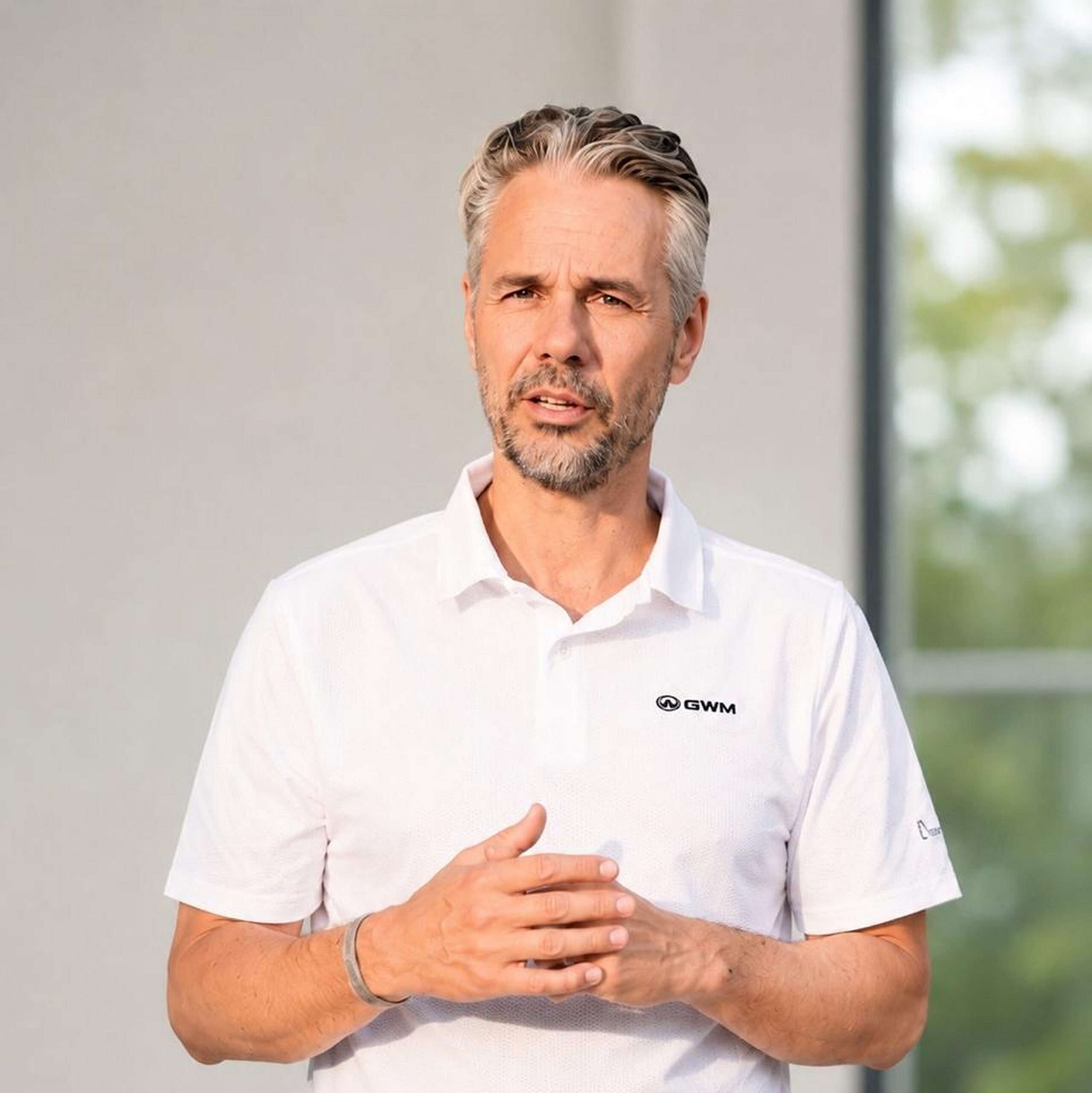
Michele Scotti – an Italian – has been in Mzansi for only less than 72 hours. He likes the weather. Fair enough. When GWM Sout Africa told me their Powertrain Director would be in the country, I immediately expected a Chinese man.
Scotti (the Michele is pronounced me-kheh-lee) is GWM’s Powertrain Director for the past three years. Previously, ten years at General Motors, ten years at McLaren. Now China. He talks like an engineer who has had to become a businessman. And that is pretty much how he describes the jump.
“I’m learning more and more, which is the reason I keep changing,” he told me at Festival of Motoring, powered by WesBank.
GM was volume. McLaren was niche and high performance. China forced a reset. Things are done differently. The potential still sitting there, he said, is “great.”
He also claims he saw it coming. Fifteen years ago, still at GM, he had a small run-in with a Chinese company and told himself to watch the market. “They might dominate.” That is the frame. Everything else hangs off it.
HI4, AS HE TELLS IT, IS NOT A STICKER
I have heard GWM’s Hi4 suite being used like another hybrid slogan. Scotti pushed it the other way. Hi4, he said, is an architecture, not a single part.
Motors. Batteries. Petrol engines. Diesel engines. DCTs. Ordinary automatics. Even two-speed gearboxes meant to work with e-motors. Build the pieces, put them on the table, then pick for the market.
“South Africa is different to Italy, different to Thailand, different to Australia, and definitely different to China.”
Too many new-energy pitches still treat the world as one charging-map problem. He is arguing for a manufacturer that wants to be global without pretending Gauteng drives like Shanghai.
HE THINKS EVS WIN. HE WILL NOT GIVE ME A DATE
I asked where powertrains go if governments get out of the way. He did not sell me a romantic story about combustion living forever.
Legislation has driven efficiency for twenty years, yes. The destination, in his view, is still electrification. EVs become the majority. Friends ask him about EVs. Same answer every time: when, not if.
A real battery breakthrough; same range, half the weight or half the price, and the combustion engine starts looking like clutter. Packaging. Subsystems. A radiator big enough to hurt the aero.
Until then, he wants a menu. Old Italian logic: under 10 000km a year, petrol. Over 15 000km, diesel. Now there are more boxes. A full EV doing 100 to 300km every day may be the wrong tool.
Five years. Ten. Fifteen. A “plethora” of applications. Thirty years out, more EVs. He would not nail the date. I would not have believed him if he had.
THE 3.0-LITRE THAT IS NOT A V6
This is the part I came for.
While much of the industry is shrinking engines, GWM has a V8 from Shanghai and a 3.0-litre turbodiesel coming the other way. We wanted to know why they are walking against traffic.
The V8, he said, is niche, premium, flagship. Not tens of thousands of units. A supercar programme that also does marketing work: GWM as more than SUVs. And the first V8, he was careful to say, fully developed in China. Other V8s in Chinese metal still trace back to Germany, Europe or the United States.
The diesel is the opposite instinct. Not a trend. A customer. Torque. Desert. The work a bakkie or a serious off-roader still has to do when the charging post is a rumour.
Then I asked the question that needed asking: is this diesel a V, and at what angle?
It is not a V, apparently. It is a four-cylinder.
He enjoyed that. Why should a 3.0-litre always be a V6? Maybe marketing. “3.0-litre V6” sounds like a brochure. Engineering, he said, picks the layout for the job. They wanted a compact engine, not the width of a V6, mounted longitudinally and hooked to an automatic, not a transverse package.
Four-cylinders can feel rougher than a six, so there is a balance-shaft system of the sort you usually find in premium applications. The claim is V6-like vibration. Also, the block is cast iron, not aluminium. Weight penalty accepted. Robustness first. GWM has its own foundries and could go aluminium. The internal brief is 300 000 kilometres. That is the mission.
Single turbo, not sequential twins. He has done sequential turbos on a 1.6. Expensive. Complicated. On this engine, reliability wins the trade. If you sell bakkies and body-on-frame SUVs in this country, that paragraph is the story. Not the supercar render.
THROTTLE, HIGHVELD AIR, AND THE CHINA CALIBRATION PROBLEM
Chinese product arriving here still has a habit of feeling sleepy at the pedal. We put that on the table. He did not dodge it. They call it localisation. Part of his job is driving European-spec versions, because he drives like a European. The China-market car arrives with a long list. Mostly calibration. More reaction. Standing at Khayalami, he said it is closer to Italy than to Beijing traffic, where smoothness beats punch.
Then I gave him our problem. Roughly half our market lives in Gauteng, around 1 700 metres in altitude. Cars sold in this country have to work thin air as a default, not as a holiday.
His answer was extreme testing. Siberia. High desert. The Tibetan plateau. Lab simulation to 5 000 metres. Mountain passes to 4 800m. You do not always keep every Newton-metre. Physics takes a cut. They leave calibration margin so the engine can still make the same torque when you climb.
That is the right language for most. Whether the cars I drive next year match it is a road-test question, not a pit-lane one.
THE V8 I WOULD NOT LEAVE IN ONE BODY STYLE
Scotti joined GWM for the upcoming supercar, he admits. That is the day job. High-performance PHEV, part of it already shown in Shanghai (2025) and Beijing (2026). He is also pulled across other programmes as consultant if not chief engineer, moving know-how between teams.
Last year in China I heard GWM’s existing eight-cylinder – the non-V unit driving the SOUO motorbike – at idle. It already sounds like it wants a special occasion. Keeping a proper in-house V8 locked in a supercar would be a waste of an architecture, I venture. Other products in this line-up would wear it without apology, I probe further.
He would speculate, carefully. That engine does not belong in “this” kind of car. It could belong in another, in a different state of tune. Worldwide, he says, nobody develops that kind of engine for one body style. I have my answer, even if it is only half an answer. In the same vein he could not confirm a Tank 500 with a V8, nor did he close that door.
WHAT I TOOK AWAY
Scotti is not selling “diesel forever” and he is not selling “EV next Tuesday.” He is selling a company trying to own the whole drawer: motors, batteries, fours, eights, two-speed hybrids, and then dress the powertrain for the country it is standing in.
For us, the useful sentence is the unfashionable one: a compact, iron-block, single-turbo 3.0-litre four-cylinder diesel, designed to last 300 000km, with altitude baked into the calibration, and a V8 programme running in parallel as proof they can do more than copy.
Whether that diesel changes how I rank GWM will not be decided on a single encounter at the Khayalami Grand Prix Circuit. It will be decided on a farm, at a factory, at a construction site, on the N3, on a Highveld on-ramp, and on a gravel road when the last bar of signal dies.
That is the test he described. I just live it.